
Navigating today’s competitive job market requires far more than just showing up and doing your daily job well. Hard work alone rarely guarantees a promotion or a salary increase in modern corporate environments. Applying targeted career advancement strategies gives you a massive advantage, helping you stand out to decision-makers and climb the professional ladder faster. Whether you want to step into leadership, transition to a higher-paying role, or future-proof your skill set, adopting proactive growth habits will transform your career trajectory. Taking charge of your professional path starting today unlocks exciting opportunities, higher earnings, and long-term career satisfaction.
Building a Purposeful Career Framework for Fast Growth
Unlocking steady career progression starts with treating your career like a high-growth startup where you serve as the chief executive. Waiting for management to recognize your talent usually leads to frustration and missed opportunities.
Implementing active career advancement strategies requires intentional planning, visible achievements, and continuous alignment with company goals. Instead of focusing solely on daily tasks, successful professionals position themselves around high-impact business outcomes.
Building visibility within your organization matters just as much as delivering quality work. When senior leadership notices your ability to solve complex problems and lead initiatives, promotion opportunities naturally follow.
Essential Pillars of Professional Growth
Accelerating your career journey requires a balanced approach that combines technical expertise with executive presence. Focusing on core development pillars positions you as an indispensable talent within your organization.
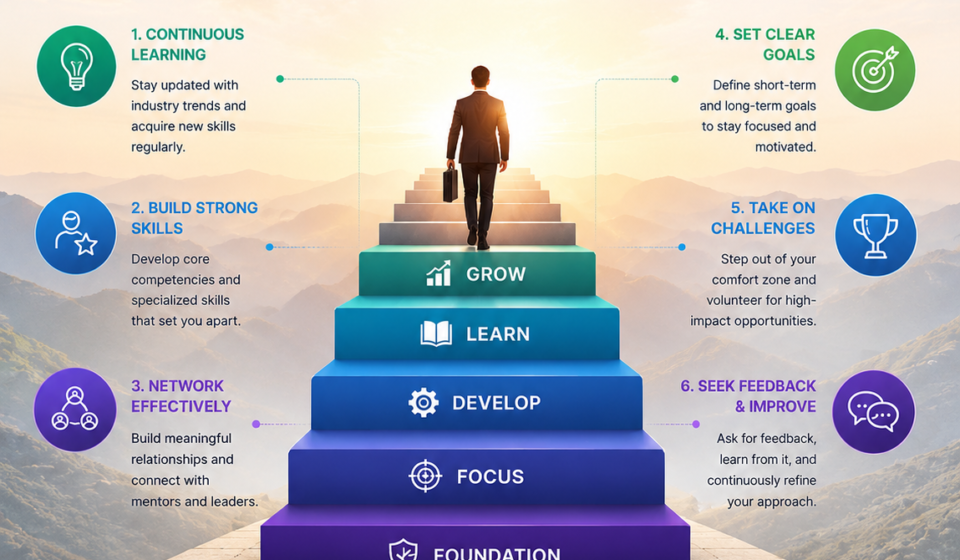
- Strategic Networking: Building meaningful workplace relationships across departments, industries, and executive levels to discover hidden opportunities.
- Continuous Upskilling: Mastering emerging industry tools, earning relevant professional certifications, and refining high-value soft skills like public speaking.
- Proactive Personal Branding: Sharing professional insights on industry platforms like LinkedIn to build authority within your niche field.
- Quantifying Accomplishments: Tracking concrete metrics, cost savings, and revenue contributions to present during performance reviews.
Actionable Tip: Conduct Monthly Accomplishment Audits
Set aside fifteen minutes at the end of every month to document your key wins, project milestones, and positive feedback from stakeholders.
Maintaining a dedicated “brag sheet” with real numbers makes performance evaluations stress-free and gives you immediate leverage when asking for a raise or promotion.
Growth Approaches Comparison: Reactive vs. Proactive Planning
Understanding the difference between passive job performance and active career management helps you focus your energy on high-return activities.
| Growth Approach | Daily Focus | Visibility Level | Promotion Timeline |
| Reactive Career Management | Completing assigned tasks | Low (Known only to immediate manager) | Slow (Dependent on annual review cycles) |
| Proactive Career Advancement | Solving broader business problems | High (Cross-departmental and executive recognition) | Fast (Driven by strategic merit and initiative) |
| Lateral Skill Expansion | Mastering adjacent team roles | Medium (Recognized as a flexible team player) | Moderate (Prepares you for broader leadership) |
| Executive Mentorship | Aligning with senior leadership goals | High (Direct advocacy from decision-makers) | Fast (Accelerated by sponsor recommendations) |
Practical Takeaways and Future Workplace Outlook
Adopting structured career advancement strategies puts you firmly in control of your professional destination. By combining continuous skill development, strong workplace relationships, and clear personal branding, you create an unstoppable momentum that propels you toward executive roles.
As automated tools reshape modern industries, technical adaptability and emotional intelligence will become even more valuable assets for rising leaders. Stay curious, document your impact consistently, and continuously position yourself where your contributions deliver maximum value.
Frequently Asked Questions (FAQs)
What are the most effective career advancement strategies for introverts?
Focus on one-on-one networking, document your achievements meticulously in writing, and build influence by sharing expertise through team documentation or written proposals.
How often should I update my career development plan?
Review your career goals every six months to align your skill development with shifting industry trends and organizational priorities.
What is the fastest way to get promoted at work?
Take ownership of high-visibility projects that solve major pain points for your manager or department while quantifying the financial or operational impact of your work.